Intergenerational Business Transfer Calculator
When a parent sells the company to a corporation the children control, section 84.1 can turn the sale into a taxable dividend, unless the intergenerational-transfer exception is met. Walk the conditions with the client, see which regime is available, and show what qualifying is worth: a capital gain and the lifetime exemption instead, then turn it into a client-ready letter.
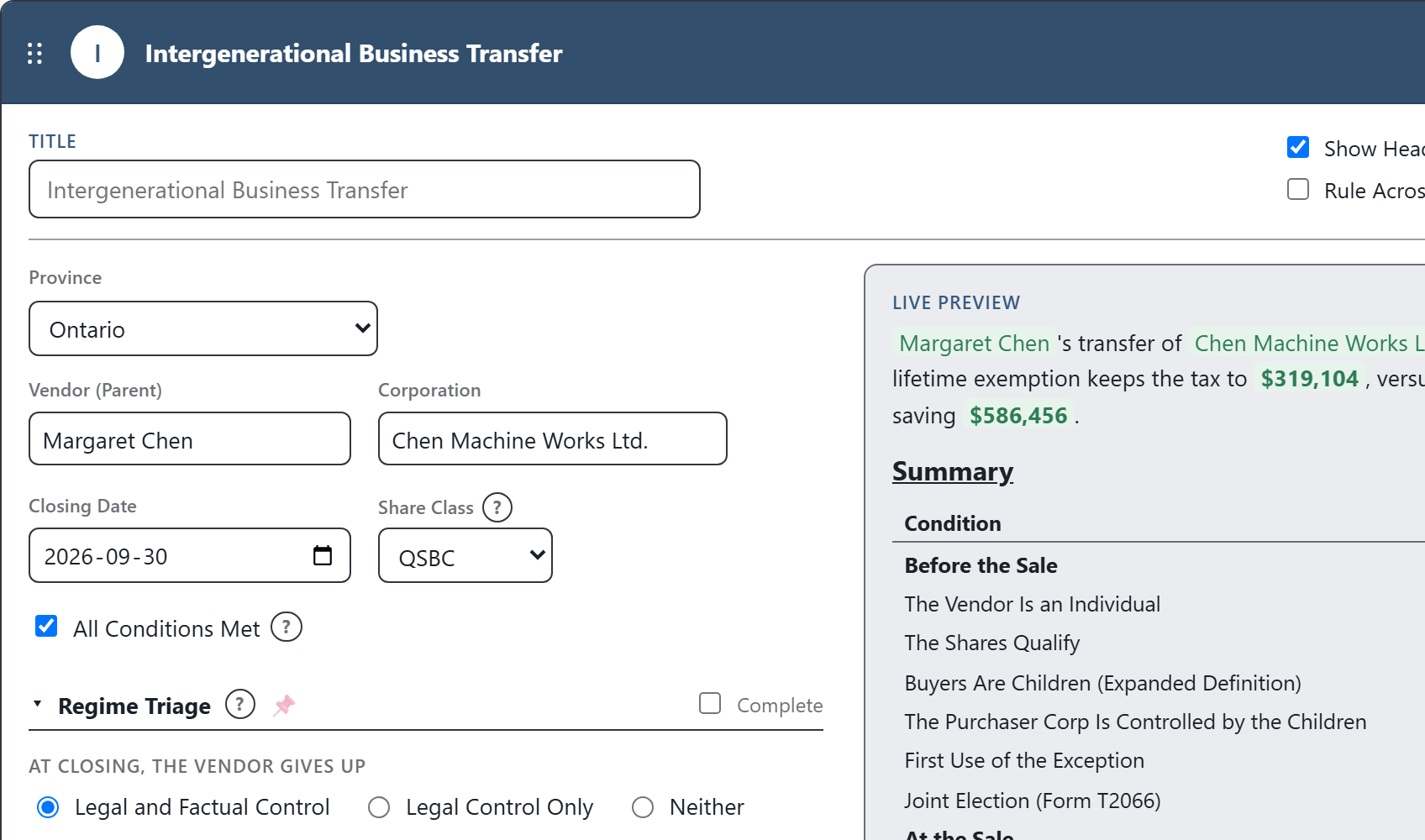
The calculation is only half the work. CodaraFlow finishes the explanation, the tables, and the client-ready letter.
The Conditions, the Regime, and What Qualifying Is Worth
This is one of the built-in calculations in CodaraFlow. Start with two questions about the control given up and the pace of the exit, walk the statutory conditions with the client, and enter the sale figures. It shows which regime is available and contrasts qualifying with the section 84.1 result.
- Two Questions Set the RegimeThe control given up at closing and how the parent’s remaining interest winds down decide whether the immediate regime, the gradual regime, both, or neither is available.
- A Conditions WalkthroughEach statutory condition is presented during the meeting and marked Met, At Risk, Not Met, or Not Applicable, with room for the client’s facts, which carry into the letter.
- What Qualifying Is WorthThe gain, the lifetime capital gains exemption claimed, the taxable half and the alternative minimum tax, including an optional ten-year capital gains reserve as the note is collected.
- The Section 84.1 ResultThe same sale when a condition fails: a deemed dividend, the paid-up capital and cost-base grinds, and the tax that follows, side by side with the qualifying figure.
- An Obligations CalendarDated from closing: the joint election, the share sale or wind-down, and the multi-year commitments each regime imposes after the sale.
From the Assessment to a Client-Ready Letter
The number is not the deliverable. In CodaraFlow the assessment drops straight into a letter section: the firm’s approved wording, the conditions table with the client’s facts, the obligations calendar dated from closing, the qualifying-versus-section-84.1 contrast, and the notes that apply, written in for you. Exported as an editable Word document on your letterhead.
The same reviewed explanation, not whatever the preparer types today.
The summary sentence adapts to the assessment: what qualifying is worth when the conditions are met, and a plain section 84.1 warning when one is not.
The conditions table, the obligations calendar, and the qualifying-versus-84.1 figures are laid out and footed for you.
Finish it in Word, on your firm’s letterhead. No proprietary format.
The Rules Behind the Assessment
The assessment reflects the intergenerational-transfer rules in section 84.1. The wording is firm-editable.
On a sale of shares to a corporation the vendor does not deal with at arm’s length, section 84.1 can reduce paid-up capital and deem a dividend instead of a capital gain.
The sale is spared that treatment when the buyer is controlled by the vendor’s children, 18 years of age or older, as determined under the Act, and one of the two sets of conditions is met.
Legal and factual control passes at closing and the parent’s remaining shares are sold within 36 months, with management transferred to the next generation and a child staying active in the business.
Legal control passes at closing and the parent’s economic interest winds down below the statutory threshold within ten years, with the longer commitments the slower pace requires.
The vendor and the children jointly elect for the exception, filed by the vendor’s filing-due date for the year of the sale.
The figures are a planning illustration at the firm’s current rates, and the conditions assessment records professional judgment, not a guarantee. Several conditions run for years after closing, and a later failure can forfeit the exception retroactively. Whether the exception ultimately applies depends on the facts and remains a matter of professional judgment.
Calculations Firms Reach For Alongside It
Get a working demo account, run this calculation on a real file, and export the letter it produces.
Everything is computed from the figures you enter and assembled from your firm’s approved wording. The app never connects to AI.
Editable Word documents on your firm’s letterhead. Monthly pricing, no long-term contracts.
Questions About This Calculation
Is this a standalone calculator?
No. It’s one of the built-in calculations inside CodaraFlow. The assessment and the figures become a client-ready letter section, complete with the conditions table, the obligations calendar, and the notes that apply.
Which regimes does it cover?
Both: the immediate regime under subsection 84.1(2.31) and the gradual regime under subsection 84.1(2.32). Two triage questions determine which one is available, and it walks the conditions for that regime, or compares both when both remain open.
Does it decide whether the transfer qualifies?
No. It structures the conditions so you can walk them with the client and record where each one stands, then shows what qualifying is worth against the section 84.1 result. Whether the transfer qualifies is professional judgment on the facts.
Can we change the wording and which notes appear?
Yes. Every sentence and every note is firm-editable, and can be overridden on an individual letter.
Does any client data go to an AI?
No. The app never connects to AI. Deliverables are assembled from structured facts and your firm’s approved wording.