Post-Mortem Calculator
Compare the routes for extracting the value of a deceased shareholder’s corporation, from no planning to a subsection 164(6) loss carryback, a pipeline or a hybrid, and compare the after-tax outcome of each, then turn it into a client-ready letter, not just a number on screen.
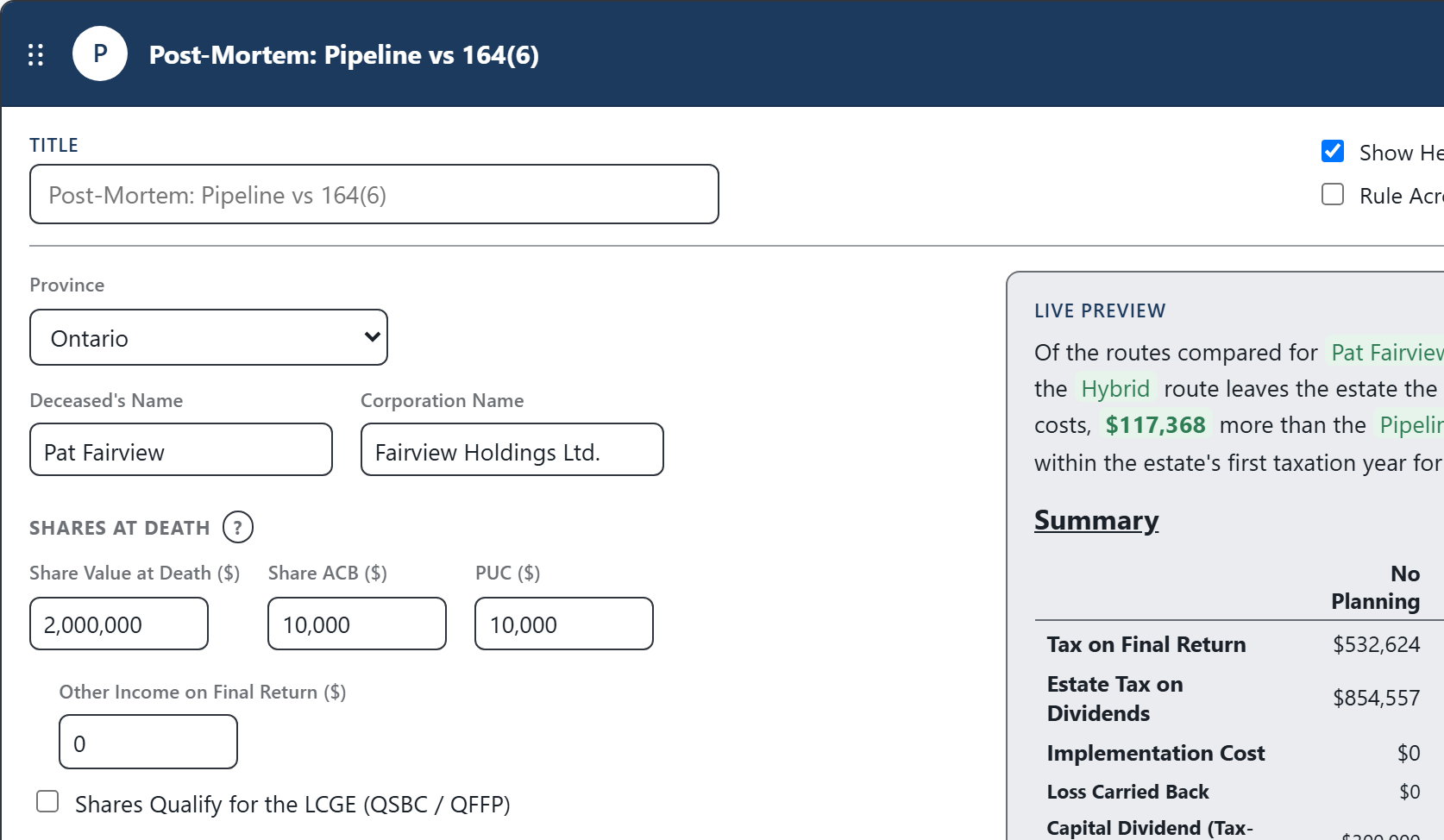
The calculation is only half the work. CodaraFlow finishes the explanation, the tables, and the client-ready letter.
Compare the After-Tax Outcome of Each Route
This is one of the built-in calculations in CodaraFlow. Enter the deceased’s shares, the corporation’s pools and the estate’s position, and it compares the after-tax cash each post-mortem route leaves the estate.
- Four Routes, ComparedNo planning, a subsection 164(6) loss carryback, a pipeline and a hybrid, side by side.
- Net Cash to the EstateThe after-tax cash each route leaves, after taxes and costs.
- The Double-Tax ExposureThe gain taxed at death set against the tax on extracting the value, which the planning is designed to relieve.
- The Pools at WorkThe capital dividend account, refundable tax accounts and available loss carryback used by each route.
- Stranded Refundable TaxWhere a pure pipeline leaves refundable tax unrecovered, the amount is flagged, and the hybrid shows the effect of recovering it.
From the Calculation to a Client-Ready Letter
The number is not the deliverable. In CodaraFlow the result drops straight into a letter section: the firm’s approved wording, the comparison tables, and the statutory notes that actually apply to this client, written in for you. Exported as an editable Word document on your letterhead.
The same reviewed explanation, not whatever the preparer types today.
The 164(6) timing, stop-loss and pipeline notes appear only when the route you choose calls for them.
The route-by-route comparison is laid out and footed automatically.
Finish it in Word, on your firm’s letterhead. No proprietary format.
Grounded in the Provisions You Cite
Each route ties to the provisions that make it work. The wording is firm-editable; the sections are fixed by the Act.
The shares are deemed disposed at fair market value on death, creating the first level of tax.
A redemption loss in the estate’s first taxation year may be carried back to offset the deceased’s terminal capital gain, where the estate is a graduated rate estate.
Capital dividends may reduce the available capital loss under the stop-loss rules.
A pipeline generally relies on hard adjusted cost base. Basis created by a capital gains deduction may not support tax-free extraction and requires separate analysis. Pipeline planning generally requires careful implementation and timing.
A redemption or wind-up distribution in excess of paid-up capital is a deemed dividend.
The comparison covers the shares of one corporation and assumes the distributable value is extracted in full. It excludes probate and other estate taxes. The comparison models the principal post-mortem planning approaches; hybrid approaches can also be evaluated. Where subsection 164(6) is modelled, the calculation assumes the statutory conditions for a graduated rate estate are satisfied.
Calculations Firms Reach For Alongside It
Get a working demo account, run this calculation on a real file, and export the letter it produces.
Everything is computed from the figures you enter and assembled from your firm’s approved wording. The app never connects to AI.
Editable Word documents on your firm’s letterhead. Monthly pricing, no long-term contracts.
Questions About This Calculation
Is this a standalone calculator?
No. It’s one of the built-in calculations inside CodaraFlow. The result becomes a client-ready letter section, complete with the comparison table and the notes that apply, not just a figure you copy into a client letter.
Does it choose the route for the estate?
No. It compares the after-tax outcome of each route so you can plan. The choice of strategy and its implementation remain your professional judgment.
Can we change the wording and which notes appear?
Yes. Every sentence and every note is firm-editable, and can be overridden on an individual letter.
Does any client data go to an AI?
No. The app never connects to AI. Deliverables are assembled from structured facts and your firm’s approved wording.